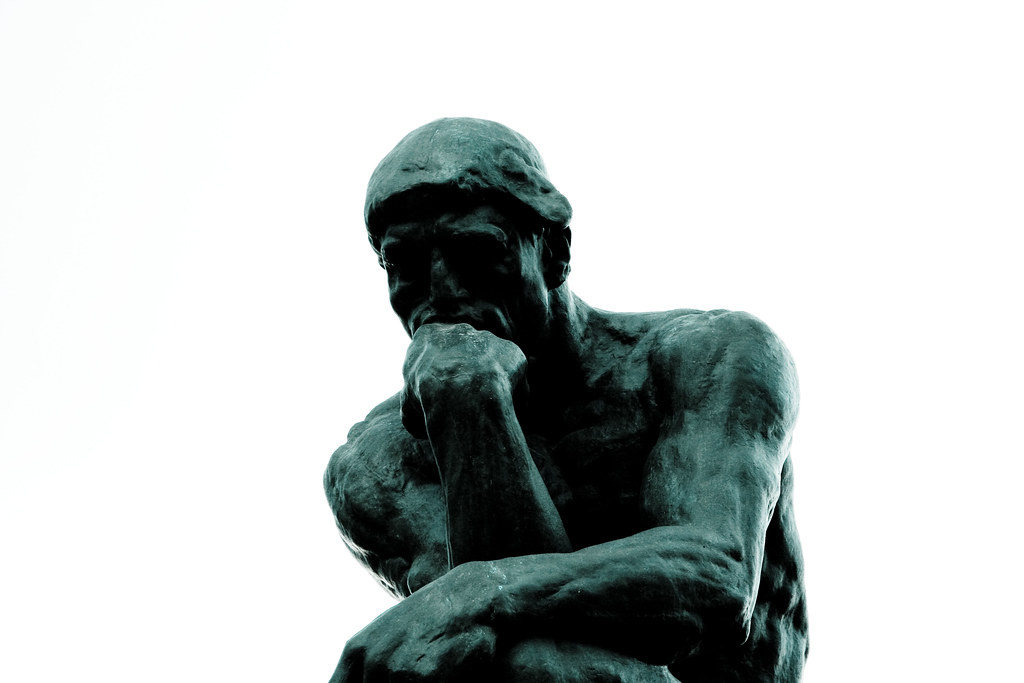
Socrates famously declared “the unexamined life is not worth living” as he drank the hemlock given to him by the state. For Socrates, death was preferable to living without philosophy. But what is philosophy? What was Socrates fighting for?
This course aims to do two things: (1) give you some insight into what philosophy is, but more importantly (2) teach you the skill of doing philosophy. It’s one thing to read what philosophers have said, and it is quite another thing to practice being a philosopher yourself.
What do philosophers do? We ask the big questions confronting humans such as, how should we live? What is the nature of reality? Does God exist? What is the meaning of life? Then we try to answer some of those questions with arguments. We use the power of the mind to present good reasons for our conclusions or to uncover false assumptions and logical mistakes in others’ arguments (and our own).
What will you do? My hope is that you’ll read what some other very smart people have to say about ethics, the nature of reality, God, the meaning of life, etc. But beyond that, I want you to think critically about ethics, the nature of reality, God, the meaning of life, etc. The goal is not to change your mind about anything. Rather, the goal is to get you to see the reasons for and implications of what you believe, so that your beliefs may be better grounded in argument, too.
Weekly Topics
How should you move through this course? I recommend starting at the beginning and going in order. Read the readings (housed in my personal Google Drive Folder) and watch the videos in the order they’re presented, while carefully considering the leading questions provided. If you would like to reach out to me directly to discuss, I’m happy to do so! You can also leave comments on this document, on social media, or in the Reason and Virtue blog comments section.
Recommendations for improvement or suggestions for cool new content are welcome! Feel free to use any part of this for your own teaching and learning purposes, but please do not publish any part of this for financial gain.
Why Study Philosophy?
Read: Russell’s “The Value of Philosophy” and consider these questions:
- What is the difference between philosophy and science?
- Why does Russell think uncertainty is so important?
- What is the difference between a philosophical person and an instinctive person?
Watch: Socrates on Self-Confidence
Read: Plato’s Apology and consider these questions:
- Socrates is charged with two crimes: (1) corrupting the youth of Athens, and (2) not believing in the gods of Athens. Be sure to keep close track of which crime he’s defending himself against in his speech. Do you think his defense is good? Why or why not?
- Socrates essentially receives the death penalty for his crimes. Do you believe this is justified? Why or why not?
Read: “Why Marc Cuban Would Major in Philosophy Today”
Discuss: Bertrand Russell argues that the value of philosophy lies in its uncertainty. Think for a bit about something you’re currently uncertain about. Some examples might include: whether billionaires should be taxed more, whether or not new parents should have paid paternal leave, whether or not people should go to prison for nonviolent crimes such as doing drugs, whether true AI is possible, whether or not parents should spank their children and so on. Feel free to pick something you’re currently on the fence about that’s not in that list. Discuss the multiple options on the table—what are all the possible things a person could believe about removing billionaire taxes, paternal leave, drug offenses, etc.? After discussing the options on the table, explain why you are not yet ready to draw a conclusion. What’s holding you back? How does it make you feel to continue being uncertain?
Question: This first week is all about trying to understand what philosophy is and how it differs from other ways of thinking and academic disciplines. In our first Q&A this week, I’d like to hear what you think about philosophy. Feel free to answer any/all of the leading questions below or make up your own question. As always, if you see some fantastic philosophical references on social media or in the news, feel free to share!
- Have you ever read, studied, or thought much about philosophy before? How did the first week’s readings, videos, and assignments compare to your preconception of philosophy?
- Had you ever heard someone argue for the value of uncertainty or suspending judgment? What do you think about that? Do you agree that it’s sometimes better to not make up your mind?
- Did you previously know the story of Socrates’ death? I think it’s a powerful story that still resonates today. What do you think?
- You could also take a more practical approach to this week’s readings and think about the knowledge and skills learned and developed through studying philosophy. How might thinking more philosophically help you with what you want to do when you finish college?
What is an Argument?
Watch: Crash Course’s How to Argue
Read: Thinking Well Chapter 1
Read: Thinking Well Chapter 4
Discuss: First watch Michael Huemer’s TED Talk, “The Irrationality of Politics,” and then consider the following questions:
- What are the two irrational policies Huemer discusses?
- Why does Huemer think people are so irrational about politics? Do you find his argument to be persuasive? Why or why not?
- Why does Huemer think that political rationality is costly? Do you believe we should just believe whatever we want or do you believe we should believe based on reasons and evidence? Are the two so opposed?
- Do you agree that the biggest problem facing society today is the problem of political irrationality? Why or why not?
Question: We’ve been reading about good and bad arguments. I’d like for you to go out and find an example of a bad argument online somewhere. It could be an opinion piece/editorial or a Tweet—bad arguments are everywhere. Share a screenshot or link to your bad argument example, and then explain why it’s a bad argument. Is some fallacy committed? Does the conclusion not follow from the premises? Is there a false premise? Be specific about what’s gone wrong.
Utilitarianism
Watch: Crash Course’s Utilitarianism
Read: “Utilitarianism Overview” and consider the following questions:
- Do you believe that the consequences of a person’s actions or the intention behind the person’s actions matter more? Why?
- Do you believe that pleasure/happiness is all that’s important to a good or meaningful life? Why? If something else matters, what is it? How would you define pleasure/happiness?
- Is it right to harm one (or some) in order to increase pleasure/happiness for many (or most)? Why or why not?
- Are you a Utilitarian? Why or why not?
Read: Selections from Bentham
Read: Selections from Mill
Discuss: Consider the famous ethical dilemma called “The Trolley Problem,” which asks us to imagine we’re on a trolley, and if we do nothing, then the trolley will run over and kill 5 people tied to the main tracks ahead. However, we could choose to pull a lever, switch the tracks, thus only killing one person tied to the alternate tracks ahead. What should we do? Utilitarians have a fairly straightforward answer to the question, as demonstrated in the utility calculation below (assuming a maximum of 10 utiles of pleasure/-10 utiles of pain is possible).
Choice A: Stay on the main track, killing persons 1, 2, 3, 4, and 5
Choice B: Pull the lever to switch to the alternative track, killing person 6
| A | B | |||||
| Pleasure | Pain | Net Utility | Pleasure | Pain | Net Utility | |
| Person 1 | 0 | -10 | -10 | 10 | 0 | 10 |
| Person 2 | 0 | -10 | -10 | 10 | 0 | 10 |
| Person 3 | 0 | -10 | -10 | 10 | 0 | 10 |
| Person 4 | 0 | -10 | -10 | 10 | 0 | 10 |
| Person 5 | 0 | -10 | -10 | 10 | 0 | 10 |
| Person 6 | 10 | 0 | 10 | 0 | -10 | -10 |
| Total: | -40 | 40 | ||||
Based on the results of the utility calculation above, the Utilitarian says we ought to choose B, pull the lever and switch the tracks, because choice B produces more net utility than choice A (the total for net utility is higher in B than in A).
First, watch this clip of the trolley problem in live action on “The Good Place” (warning: there is some serious fake blood shown):
- This video shows Variation 1: what if the one lone person on the alternate tracks (person 6 in the calculation above) is a friend or family member? Would you still choose B? Is B still the morally right thing to do? Why or why not?
Second, watch this clip of the trolley problem.
- This video shows Variation 2: what if instead of simply pulling a lever to divert the trolley, you had to push a large person off a bridge? Would you be willing to push one person, sacrificing their life, to save the others on the tracks? It’s still one versus many, but has your view changed? Why or why not?
Third, watch this segment (beginning at 7:30) of this week’s Crash Course video about a related Utilitarian thought experiment called “Medical Sacrifice.”
- This video shows Medical Sacrifice: a similar “trolley problem-style” calculation of 1 versus 5, but many have taken it to be a very different case from the trolley problem. What are the differences? Do those differences make a moral difference? What should the surgeon do? Why?
Question: One of the most famous examples of Utilitarianism was President Truman’s decision to drop nuclear weapons on Hiroshima and Nagasaki to end WWII in the Pacific. Here’s an explanation of his reasoning from Philosophy Now:
“Within a few weeks of Truman becoming president, the war in Europe ended with the defeat of Germany. Truman also received word that the United States had developed a nuclear bomb capable of tremendous destruction. He was required to decide whether to use this weapon on the Japanese to bring about their quicker surrender and the final conclusion of the war. It could be assumed that with the end of the war in Europe, an invasion of Japan would be successful, and that the war could be ended with the conquest of Japan. However, to do this would cost a lot of human lives. Since the invasion never took place, it is impossible to know how many Allied soldiers would have died in the invasion. Truman heard estimates that put the death toll in the range of 500,000 to 1,000,000 Allied casualties. Truman was also aware of the continuing slaughter of Japanese from ongoing non-nuclear bombing, which had already cost the Japanese some 100,000 lives. Dropping atomic bombs and forcing the Japanese to surrender would not only save Allied and American lives, it would end further futile Japanese soldier and civilian deaths as well. So Truman decided to use nuclear weapons on utilitarian grounds. He reasoned that dropping the atomic bombs would ultimately cost less lives – Allied, American and Japanese – than would the continuing conventional bombardment of Japan coupled with the deployment of a huge military force on the Japanese Islands. And the use of the atomic bombs did end the war.”
Do you think that dropping the nuclear bombs on Japan was justified on Utilitarian grounds? You might be inclined to think that sacrificing some to save many is often justified, but not always. What are the limits of Utilitarian justifications? Under what conditions might it be flat out wrong to sacrifice one to save others?
Reflect:
- Do you believe that the consequences of a person’s actions or the intention behind the person’s actions matter more? Why?
- Do you believe that pleasure/happiness is all that’s important to a good or meaningful life? Why? If something else matters, what is it? How would you define pleasure/happiness?
- Is it right to harm one (or some) in order to increase pleasure/happiness for many (or most)? Why or why not?
- Are you a Utilitarian? Why or why not?
Kantian Ethics
Watch: Crash Course’s Kant and Categorical Imperatives
Read: Kantian Ethics Overview and consider the following questions:
- Do you believe that moral rules are without exception? That is, if it’s wrong to lie, then it’s always wrong to lie. Justify your answer.
- Which of the following do you believe: (A) it’s better to steadfastly do what you ought to do even though you do not want or care about doing it or (B) it’s better to both believe you ought to do it and also want or care about doing it? That is, do your desires and emotions matter to morality? Justify your answer.
Read: Selections from Kant
Discuss: A central tenet of Utilitarianism and Kantian Ethics is that the ethical principles (the Principle of Utility and the Categorical Imperative) are universal, meaning that the principles apply to everyone regardless of time, culture, acceptance of the principle, or any other condition. They believe morality does not change from person to person or from culture to culture. Furthermore, Bentham, Mill, and Kant all believed there are “moral experts,” those who have spent more time and energy thinking about ethics; those who we ought to turn to for advice and expertise on what to do and how to live.
Neuroscientist Sam Harris also believes that moral principles are universal and that there are moral experts, and he expresses both views in his TED Talk, “Science can answer moral questions.” After watching the video, consider the following questions:
- How does Harris define facts and values? Does he think there is a big difference between facts and values? Why or why not? Do you agree or disagree with Harris?
- Harris believes there are (many) right and wrong answers to questions about how human beings flourish (about what’s morally right and wrong), just as there are right and wrong answers to questions of physical health or healthy food. What reasons does he give for this statement? Do you agree or disagree? Why or why not?
- Harris claims, “When talking about morality, we value differences of opinion in ways we would not in any other area of our lives,” before asking whether you’d take moral advice from the Dalai Lama or Ted Bundy. He also gives an example of a physics professor’s contribution to a professional conference versus his own contribution. What’s he getting at here? Should everyone’s opinion about morality count equally or should some moral experts (if they exist) get more of a say? Why?
Question: Now that we’ve studied both Utilitarianism and Kantian Ethics, which theory do you like more?
Reflect:
- Do you believe that moral rules are without exception? That is, if it’s wrong to lie, then it’s always wrong to lie. Justify your answer.
- Which of the following do you believe: (A) it’s better to steadfastly do what you ought to do even though you do not want or care about doing it or (B) it’s better to both believe you ought to do it and also want or care about doing it? That is, do your desires and emotions matter to morality? Justify your answer.
- Are you a Kantian?
Virtue Ethics
Watch: Crash Course’s Aristotle and Virtue Theory
Read: Aristotelian Virtue Ethics Overview and consider the following questions:
- Do you believe ethics is mostly about performing right actions (and avoiding doing the wrong thing) or do you think it’s more about learning how to be a good person (and avoiding being a bad one)? Justify your answer.
- Do you believe that being a good person requires the having right kinds of beliefs, emotions, and actions? Why or why not?
- Can someone live a happy life without being a good person? Why or why not?
- Are you a Virtue Ethicist?
Read: Selections from Aristotle
Discuss: Construct a profile of a virtuous person. Feel free to choose someone you know personally—a grandparent, friend, or mentor—or someone who is famous. The person need not be currently living. Give a detailed account of what makes this person virtuous, making reference to the essential concepts in Virtue Ethics to support your ideas.
After constructing your profile of a virtuous person, consider whether this person has any flaws. Have they ever made a mistake? Do they possess any vices? What are they?
Given that the most virtuous person one often considers also possessed some vices, what does this mean for Virtue Ethics? Virtue Ethics says that the right thing to do is what the Virtuous Person does or would do. But what if all so-called ‘Virtuous Persons’ also possess some vices? How do we know which things that a Virtuous Person does are right and which things are wrong? Be sure to consult the Overview of Virtue Ethics and Its Problems and the Crash Course video in formulating your analysis.
Question: Utilitarianism and Virtue Ethics are both focused on happiness. For Utilitarians, happiness is a feeling like pleasure. But for Virtue Ethics, happiness (or eudaimonia) is more like flourishing, living a good life. Happiness is fleeting for the Utilitarian and long-lasting for Virtue Ethics. Which understanding of happiness do you think is more important to ethics?
When you answer this question, also think of the opposite of happiness, pain or suffering. Does the argument you give about which understanding of happiness matters ethically speaking, does the same apply to suffering? Why or why not?
Reflect:
- Do you believe ethics is mostly about performing right actions (and avoiding doing the wrong thing) or do you think it’s more about learning how to be a good person (and avoiding being a bad one)? Justify your answer.
- Do you believe that being a good person requires the having right kinds of beliefs, emotions, and actions? Why or why not?
- Can someone live a happy life without being a good person? Why or why not?
- Are you a Virtue Ethicist?
The Nature of Reality
Watch: Crash Course’s Leonardo DiCaprio and The Nature of Reality
Read: Plato’s Allegory of the Cave and consider the following questions:
- What is real? Is the cave real? Are the shadows real? Are the shackles real? Is the light from the fire real? Are the puppets and artifacts real? What about the light of the sun outside the cave?
- How do we know whether the light from the fire inside the cave or the light from the sun outside the cave is “real reality”? How can we tell which one is mere appearance?
- The first of these questions is a metaphysical question about what exists. The second is an epistemic question about how we can know or have access to or believe propositions about what exists (or doesn’t). Is it easy to confuse these two types of questions? Why or why not?
Watch: Appearance vs Reality
Read: Selections from G.E. Moore. It will be helpful to have the following argumentative background in mind as you read this.
Begin with what’s called the skeptical argument, in this case based on the thought that we might be dreaming:
- Premise 1: If I do not know I am dreaming, then I do not know external objects exist.
- Premise 2: I do not know I am not dreaming.
- Conclusion: Therefore, I do not know external objects exist.
This classic argument is an example of modus ponens, which looks like this:
- If P, then, Q
- P
- Q
Moore’s approach is not to attack the premises of the skeptical argument, but rather, to change the modus ponens into an equally valid modus tollens argument, which has the following form:
- I f P, then Q
- Not-Q
- Not-P
Here’s Moore’s modus tollens argument based on the same Premise 1:
- Premise 1: If I do not know I am dreaming, then I do not know external objects exist.
- Premise 2: I know that external objects exist.
- Conclusion: Therefore, I know that I am not dreaming.
Then, in the selection provided, Moore does offer a proof of Premise 2, as follows:
- Premise 1: Here is one hand, and here is another.
- Conclusion: Therefore, external objects exist.
Finally, Moore claims he need not defend his Premise 1: “Here is one hand, and here is another,” because that’s not the issue for the skeptic. The skeptic only needs proof of the conclusion, “external objects exist.” Has Moore been successful in his proof?
Discuss: Watch Anil Seth’s TED Talk, “Your brain hallucinates your conscious reality,” and then consider the following questions:
- What are the two broad types of things that we are consciously aware of? Are there important differences or similarities in the ways we experience these two things?
- Do you think Seth also believes G.E. Moore’s Premise 1: “Here is one hand, and here is another”? Why or why not?
- What does Seth mean when he says “the brain’s best guess of the causes of sensory information” and how is that different from someone saying “the brain perceives objects”? How does Seth’s claim help to establish his conclusion that perception is active and not purely passive? Do you agree? Why or why not?
- What does Seth mean when he says, “we’re hallucinating all the time; it’s just that when we agree about those hallucinations, we call that reality”? Do you agree that reality is a controlled hallucination? Why or why not?
Question: So what do you think? Do external objects really exist? Can we ever observe or have knowledge of the true nature of reality? Does this question even matter outside a philosophy classroom?
Feel free to also share any books, movies, or other fun media you’ve seen/enjoyed that ponders similar questions!
Reflect:
- It is crucial this week to keep the following questions separate: (1) the metaphysical question, “What is the nature of reality?” and (2) the epistemological question, “Can we know the true nature of reality? If so, how?” Many mistakes are made by conflating these two questions. Have you seen any evidence of confusing these two questions in any readings or videos for Week 6?
- According to G.E. Moore, he does not need to rule out the skeptical hypothesis that we might be dreaming in order to prove that external objects exist. Instead, all he needs for that proof is to observe his own two hands. However, others continue to argue that Moore must also prove that he has two hands—something Moore insists he need not prove. What do you think? Can we know that we have two hands or not?
- In Plato’s Allegory of the Cave, do you think you are inside the cave looking at artifacts or outside of the cave looking at real objects? How might you know the difference?
- Finally, the big question, do you believe that the external world really exists and we can have knowledge about it or do you think maybe the external world exists or maybe it doesn’t, but because of limitations on human perception, we can never know the truth?
Belief in God
Read: St. Aquinas’s The Five Ways
Watch: Crash Course’s The Ontological Argument
Read: St. Anselm’s The Ontological Argument
Watch Lindsey walk you through Aquinas’ and Anselm’s Arguments
Watch: Crash Course’s The Problem of Evil
Discuss: After reading Aquinas’ “The Five Ways” and watching Crash Course Astronomy’s “The Big Bang” video, you should be prepared to answer the following question: what is a more likely first cause of the universe: God or the Big Bang? Why? Another way of approaching the question is to think about what we have more evidence for: God or the Big Bang? Why?
A third way of putting the same question: if we follow any of Aquinas’ arguments all the way up to the conclusion that there is a first cause of the universe, then what follows more logically: that this first cause is God or that this first cause is the Big Bang?
NOTE: even someone who believes that God exists and that God is the creator might believe in the Big Bang. There’s nothing logically inconsistent about the two beliefs. However, there may be better and worse arguments for each conclusion. Challenging one particular argument does not amount to ruling out the conclusion altogether.
If you’re interested:here’s an article by Stephen Hawking arguing for another way of understanding the Big Bang such that there is no such thing as “before the Big Bang” because in addition to creating space, the Big Bang created time itself (Einstein’s theory of general relativity says space and time are not two distinct things, but instead it is one thing called “spacetime.”)
Question: After watching the Crash Course video on the Problem of Evil, discuss the argument here. As a reminder, here’s how the argument is expressed in the video:
- Premise 1: An all-knowing, all-powerful, and perfectly good God exists.
- Premise 2: If God is all-knowing, all-powerful, and perfectly good, then evil would not exist in the world.
- Premise 3: Evil exists in the world.
- Conclusion: Therefore, God does not exist.
The justification for Premise 2 is that God knows suffering will happen before it happens, he has the power to prevent it from happening, and if he’s perfectly good, then he should prevent it from happening. What do you think about this argument? Is it a good argument or a bad argument? Be sure to justify your answer by either showing that one of the premises is false or that the conclusion does not follow from the premises for some reason.
Reflect:
- Do you believe in God? Why or why not?
- Do you think belief in God can be justified by experience, such as perception or miracles, or do you think the belief can only be justified by pure argument? For reference, the former would be Aquinas’ arguments and the latter would be Anselm’s arguments.
- Does the problem of evil make you doubt God’s existence at all? If not, how would you explain the existence of evil in a world created by an all-good, all-powerful, and all-knowing God?
The Meaning of Life
Watch: Crash Course’s Existentialism
Read: Nagel’s The Absurd
Read: Wolf’s Meanings of Lives
Discuss: this week’s topic introduced you to two different approaches to the question “what makes a meaningful life?” Many people in today’s society would say that their goal is to live a happy life, or their one true wish for their children is to live a happy life. What is the difference between a happy life and a meaningful one? Should we pursue a happy life or a meaningful one, assuming the two types of lives are importantly different?
Take a few minutes to watch Emily Esfahani Smith’s TED Talk, “There’s more to life than being happy,” and then consider the following questions:
- Explain each of Smith’s four pillars of a meaningful life.
- Provide an example from your own life of how you’ve experienced in the past/present or how you hope to experience each of the four pillars.
- What do you think? Is a happy life or a meaningful life better? Which sort of life do you want for yourself and your loved ones?
Question: For our final topic, I want you to reflect on all the topics for this course. What was the most interesting, new, or exciting philosophical idea we discussed? What made it so interesting to you?
In addition to the exciting parts (of which I hope there were many!), sometimes discussing philosophy can be frustrating or annoying. Was there anything you read, watched, or that we discussed that felt frustrating? Maybe the lack of a clear answer or something that was super confusing comes to mind. What was it? Vent to us all!
Reflect:
- What makes life meaningful? This question might be answered in one of three ways: (i) life is absurd, (ii) pursuing projects that increase subjective feelings make life meaningful, or (iii) pursuing projects that increase objective positive value in the world makes life meaningful. Why?


 Reason and Virtue