I came back from my writer’s retreat in North Carolina this summer with a new organization and deeper insights into the central claims of my book. Take a look at the new roadmap, and let me know what you think.
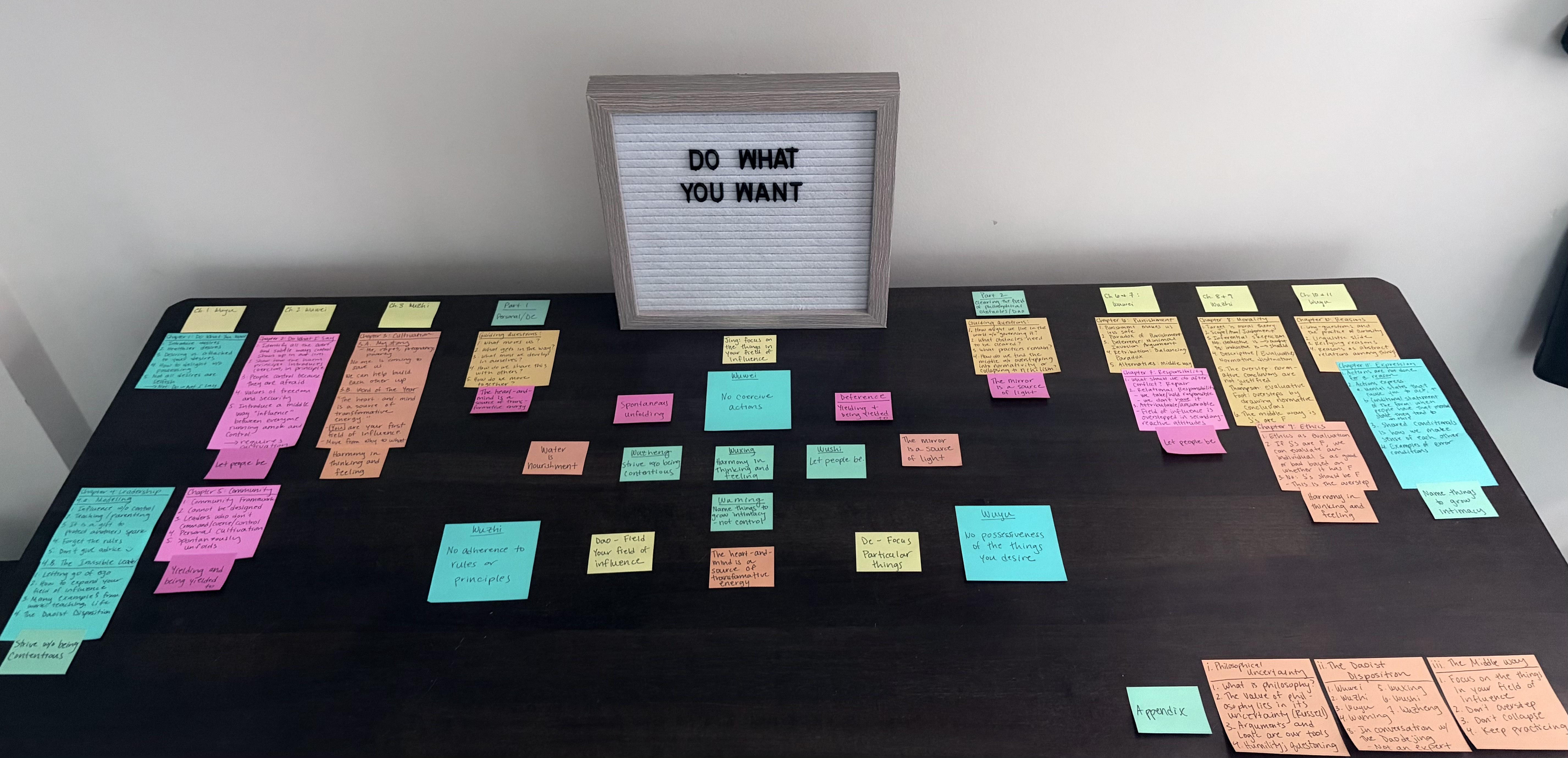
The philosophy book I’m writing called Do What You Want is a framework for critically examining the pervasive role that control plays in our lives. In my experience, being controlled by others feels really awful; it doesn’t help me flourish. I wonder what your experiences have been like? Can you think of a time when greater autonomy was actually really good for you? I want to invite you to consider whether that might also be true for others. I suspect that a gradual increase of autonomy while decreasing domination would contribute positively to human flourishing, though that’s not a claim this book will defend outright. Instead, my goal is to paint a picture of what remains for human responsibility, relationships, and agency if we practiced less control.
Doing whatever you want can be difficult for a few reasons. It is challenging to know what we really want to do. Some of the things we might want to do may not be allowed. What I want to do and what you want to do might conflict. You might want to do something that I think you shouldn’t do. You might even want to hurt me. I will address these worries throughout the three parts of this book. The first part focuses on my own life and practices. I’ve learned to exert less control over others, including my children, students, and employees. I help and I guide, but I don’t dominate them. I’m also learning to do what I want instead of blindly following the status quo, and I’ll share more about that journey with you. I think these concrete examples of my lived experience will help us transition to the more philosophical concerns in the second part. If we’re imagining a world with less control, then it would presumably have little or no punishment, for example. How would that work? Finally, the third part presents the methodological, philosophical, psychological, and spiritual influences that led me to these ideas.
I think the book works best when read from start to finish, though this roadmap will help you skip around if that’s what you prefer, because, you know, do what you want. I’ll start with some guiding questions for each part, and then give an overview of the various chapters so you can navigate the terrain. It’s a lot. It’s not finished. It’s a place to start so that we can continue the conversation together. I look forward to hearing your thoughts
Part 1: How might we cultivate more autonomy?
- What moves us?
- What gets in the way?
- What helps us grow and develop?
- How do we share what we’ve learned?
- How do we move together?
Chapter 1: Do What You Want
Doing what you want is a journey inward to discover what moves you. Coming to terms with what we really want, learning how we might shape our desires over time, and understanding that desiring isn’t inherently selfish are all part of the nuance of doing what you want. It’s also about pursuing what delights you without drifting into thinking everyone else should be moved in the same way. Doing what you want means making space for others to do what they want, too.
Chapter 2: Do What I Say
Control gets in the way of doing what we want. It’s about making people do things they might not want to do on their own. I’ll work to uncover many overt and subtle practices that attempt to control us, often under the guise of it’s for your own good. This raises questions about how we balance the freedom to do what we want with the need to protect people from harm. Rather than taking a side, I’ll argue that this is a false choice, framed in a way that introduces the very coercion I hope to avoid.
Chapter 3: Cultivation
Do What You Want is not an imperative; it’s an invitation to cultivate a life you would heartily endorse. While I couldn’t begin to tell you what, exactly, you need to develop, I will show you how I’m trying to do it. I will tell my story of trauma and abuse—and of healing. I’ve worked for many years to rebuild my authentic self through a Word of the Year exercise, which focuses more on attention and noticing and less on goals and harsh judgments. It’s meant to be an example of personal growth and not a prescriptive path you must follow. You’ll have to find your own way. Your work will look different even as we both try to cultivate the lives we want.
Chapter 4: Leadership
As we expand our field of influence, some of us may step into leadership roles. I’ll argue that good leaders nurture the spark in others. They inspire us to cultivate a life we would endorse. True leadership doesn’t require any special titles or degrees; it is embodied in sharing what we’ve cultivated with others, whether you happen to be a boss, parent, teacher, or a loving spouse. Not forcing or commanding, but facilitating others’ development. We can all be leaders simply by being good role models. In this way, leaders influence others without controlling them.
Chapter 5: Community
It’s one thing to move through life doing whatever you want as an individual, but it’s much harder to move together in a community where everyone else does whatever they want, too. As I think through how such communities are created and sustained, I will caution against a utopian version of the “perfect” community, which eventually requires its designers to control group members who may freely choose to deviate from the ideal. This risks forcing community members to follow the designer’s compass rather than their own, recreating the very control structures this book questions. Instead, I’ll discuss strategies for facilitating the growth of any community. This creates space for the community to spontaneously unfold, like a meadow. As I yield to you, and you yield to me, we build many different worlds together.
Part 2: What philosophical obstacles need to be cleared?
- Does punishment really keep us safe?
- Can we force someone to take responsibility?
- Is there one way everyone ought to live?
- Can we pursue human flourishing without moral prescriptions?
- How might we justify judgments about better and worse ways to live?
- What remains of human agency after the obstacles are removed?
Chapter 6: Punishment
The first obstacle I will question is punishment. Punishment of children, in schools, and through the criminal justice system is currently the most accepted example of an institutional practice built on controlling others. I’ll flip the familiar script and suggest, through a series of paradoxes, that punishing someone is actually committing the very “crime” it is meant to rectify. I’ll offer deterrence-based and retributivist-based arguments against punishment, and I’ll also consider several alternatives that may help us find a middle way between the intentional harm caused when inflicting punishment and the chaos many expect from permitting people to “run amok.”
Chapter 7: Responsibility
What remains after punishment? I’ll turn to everyday examples of conflict management in our personal relationships to show that there is a middle way between control and chaos. Just because we question punishment doesn’t mean we must abolish all accountability along with it. I’ll argue that most human relationships go through regular cycles of rupture and—hopefully—repair. How do we manage this everyday conflict? Adapting P.F. Strawson’s theory of reactive attitudes, I develop a view of relational responsibility where we, as individuals, take responsibility and hold others responsible in a variety of ways. Through considerations of attributability and answerability, I show how humans flourish under this account of relational responsibility after we clear the field of punishment practices.
Chapter 8: Morality
The second obstacle I will question might be rather surprising, but it connects to punishment and responsibility. I suspect there’s a close relationship between moral theories of right and wrong and the justification of our practice of punishment. After all, the retributivist view of punishment says that when someone does something morally wrong, they deserve to be punished. I’ll explore the ways in which morality and punishment are intertwined and suggest that morality is another socially acceptable way of controlling others. Skeptics have long questioned why the ideas of some people get to dictate what others are allowed to do, and I tend to sympathize.
My target is the formalized moral theory, not the commonsense idea that lying, cheating, and stealing might be harmful. I present the most common philosophical views as well as a few varieties of skepticism before introducing my own version of inferential skepticism, which diagnoses an overstep made by moral theorists. My view is that we overstep what could ever be justified when we infer conclusions about what everyone ought to do from premises about what some people do or even should do. I make a distinction between descriptive, evaluative, and normative judgments to show that while we overstep to the realm of the normative, there’s still much to be discovered in the middle ground of the evaluative.
Chapter 9: Ecology
What remains after morality? As we clear away right and wrong, I think better and worse remain. This evaluative middle way lies between the purely descriptive and the lofty normative, and it is in great need of philosophical excavation. Take for example the common belief that if your check engine light comes on, you should take your car to the mechanic. As human persons, we live in ecosystems of overlapping relationships. I need a car to get to work each day. Sometimes the check engine light comes on. Luckily there are mechanics with the expertise to fix my car. That’s just one vector in the myriad of ecosystems that could be studied more deeply with a philosophical ecology that resists the moral overstep. I develop the language to be able to say that someone should do this or that without drifting into universal rules, binding on everyone. The richness of navigating such relationships remains after we clear the field of prescriptive moral theories.
Chapter 10: Reasons
The final obstacle is normative reasons for action, which many philosophers think are foundational or at least necessary for any account of human flourishing. While this chapter gets a bit technical, I hope you’ll bear with me because this is probably my most ambitious contribution to philosophy of action. I will argue there is no such thing as a reason for action. I’ll show how philosophers have quietly slid from the relational meaning of X is a reason for Y to the reified version X is a reason to asking what kind of thing is a reason? This linguistic slide suggests that human rationality, morality, and normativity rest on acting for a reason. But what happens if we stay with the idea that reasons are inferential relations between two or more propositions? I develop a picture showing how relational reasons play an essential role in deliberation about what it would be better and worse to do without overstepping into normative reasons for action. This is the middle way for practical rationality.
Chapter 11: Agency
What remains after reasons for action? I’ll develop an expressive theory of action and agency that does not require acting for a reason. I’m very interested in why people do what they do, and I often wonder how people change their behaviors over time. My thin expressive view of action includes two parts: (1) mental states that cause you to act and (2) conditional statements of the form when people have such-and-such mental state, they tend to do thus-and-so. The corpus of shared conditionals is how we make sense of each other (and how we sometimes fail to do so) without relying on reasons for action. I distinguish this expressive view of action from a thicker view of agency where we more deliberately cultivate who we want to be. And so, we can finally say that doing what you want means expressing through action the person you want to be.
Part 3: The Roots
The parts above live on the surface. They’re the tree branches reaching for the sun or a flower stretching its petals in the last days of autumn; and let’s be real—sometimes it’s a thorny bramble. What’s below are the roots, the support structure that’s hidden underground. As I spent many years excavating the ideas of this book, old influences bubbled up as new connections formed. Here are a few I’d like to share so that you can use them to make your own insightful connections, too.
Philosophy
I’m not here to tell you how to live your life. The goal of this book is not to provide any answers if “providing answers” means anything like creating a new normative standard. I’m here to ask some well-formed, provocative questions and to map the implications of a few possible answers. That, to me, is the value of doing philosophy. It is a skill that we can learn together, and getting better at it will help us have more fruitful conversations. With an open mind, a curious spirit, and a bit of logic, we can enlarge our conception of what’s possible.
Daoism
I fell in love with the Daodejing. No single text has impacted me more, and its teachings are deeply embedded in this project. The Daodejing was written many centuries ago, and it’s just as relevant today. It provides more of an illustration of the Way than a set of rules or principles to dutifully follow. Sound familiar? I do not pretend to be an expert on the Daodejing or Daoism or Eastern philosophy. My engagement with the text is at the level of an interested person, but I still want to share the insights I discovered. Since I won’t be able to discuss everything in the Daodejing, I’ll focus on what I take to be the task of cultivating a Daoist disposition by embracing “wu-forms.” For example, I take Wuwei to mean noncoercive action, which encourages us to abolish punishment. Wuzhi is something like unprincipled knowing, which is shown by the shift from moral theories to philosophical ecology. Wuyu might be understood as desiring without possession; it’s about expressing our desires without making others do what we want, too. ‘Daodejing’, when understood by me, essentially means Do What You Want.
Psychology
When I read the work of others, I imagine myself in conversation with them. There’s no one I nod my head along with more than Alfie Kohn. His work on the power of internal motivation is extraordinary. I questioned punishment; Kohn sees rewards as just as bad. What do they have in common? They ask us to forget about, suppress, or underdevelop the small still voice inside ourselves that tells us what we want to do and who we want to be. If I’m doing something simply to get a prize or to avoid punishment, how can I know it’s what I truly want to do? It is important to me that the philosophy of Do What You Want is empirically grounded, and Kohn has helped me a bit with that—and he made me a better parent, educator, and leader. Thank you.
Spirituality
This one surprised me. I have long identified as an atheist. Sure, I dabbled in tarot and astrology—but those were mostly related to self-improvement, not a spiritual practice. But then I discovered the light that shines in all, and I saw immediately how the spiritual practice of the Society of Friends—commonly referred to as “Quakers”—aligned with the philosophical and psychological commitments of this project. Beyond the intellectual alignment, I felt held by the Light. And Quaker practice has much to teach us about non-violence, conflict management, nurturing each other’s inner light, and building unique ecosystems that grow and develop along different paths. I’m excited to share some of these insights with you.
And a Seed…
What if we applied this entire framework to understanding how human agents might learn to live alongside artificially intelligent non-human agents? This is the challenge of our time.